What Is a Witch, Anyway?
Pointy hats, broomsticks, bubbling cauldrons and Halloween—that's the witch most of us were introduced to. The real answer is far more interesting. So what is a witch, anyway?
Beyond the Pointy Hats, Hollywood, and Everything You Thought You Knew
Say the word witch and watch what happens.
For some people, the word immediately brings up pointy hats, broomsticks, bubbling cauldrons, black cats, and Halloween.
For others, it brings up something darker—evil, curses, devil worship, or all the frightening stories they were taught growing up.
And for still others, the word feels like coming home.
I am a witch.
And no, that does not mean what a lot of people think it means.
So let's talk about it.
What is a witch, anyway?
There Isn't One Kind of Witch
This is probably the most important place to begin.
There is no single belief system called "witchcraft" that every witch follows.
There is no universal Witch Bible.
There is no membership card.
There isn't even agreement among witches about what makes someone a witch.
Some witches practice within established religious traditions.
Some are Pagan.
Some are Wiccan.
Some are Christian.
Some work with gods or goddesses.
Some work with ancestors.
Some work primarily with nature.
Some consider their practice entirely spiritual.
Some approach witchcraft as a folk practice or craft without attaching any particular religion to it.
Some believe deeply in magic.
Others understand ritual through psychology, symbolism, intention, and the way ritual changes our relationship with ourselves.
And plenty of us exist somewhere in between.
Witchcraft is incredibly diverse because witches are incredibly diverse.
Witchcraft Is Not a Religion
This surprises people.
Witchcraft itself is a practice, not necessarily a religion.
Wicca is a religion.
Certain forms of Paganism are religions.
But practicing witchcraft does not automatically make someone Wiccan or Pagan, just as prayer doesn't automatically tell you which religion someone belongs to.
That distinction matters.
My own spirituality has been influenced by many traditions, teachers, experiences, and practices.
I am also an ordained multifaith minister.
And I am a witch.
Those things do not contradict one another for me.
They are different expressions of the way I experience and interact with the sacred.
So... Do Witches Actually Do Magic?
Well, I do.
But we should probably talk about what I mean by magic.
Magic, to me, isn't about waving a wand and violating the laws of physics.
It is intentional relationship.
It is prayer with participation.
It is taking an intention that exists inside of me and giving it form through words, objects, movement, fire, herbs, candles, symbols, timing, energy, or ceremony.
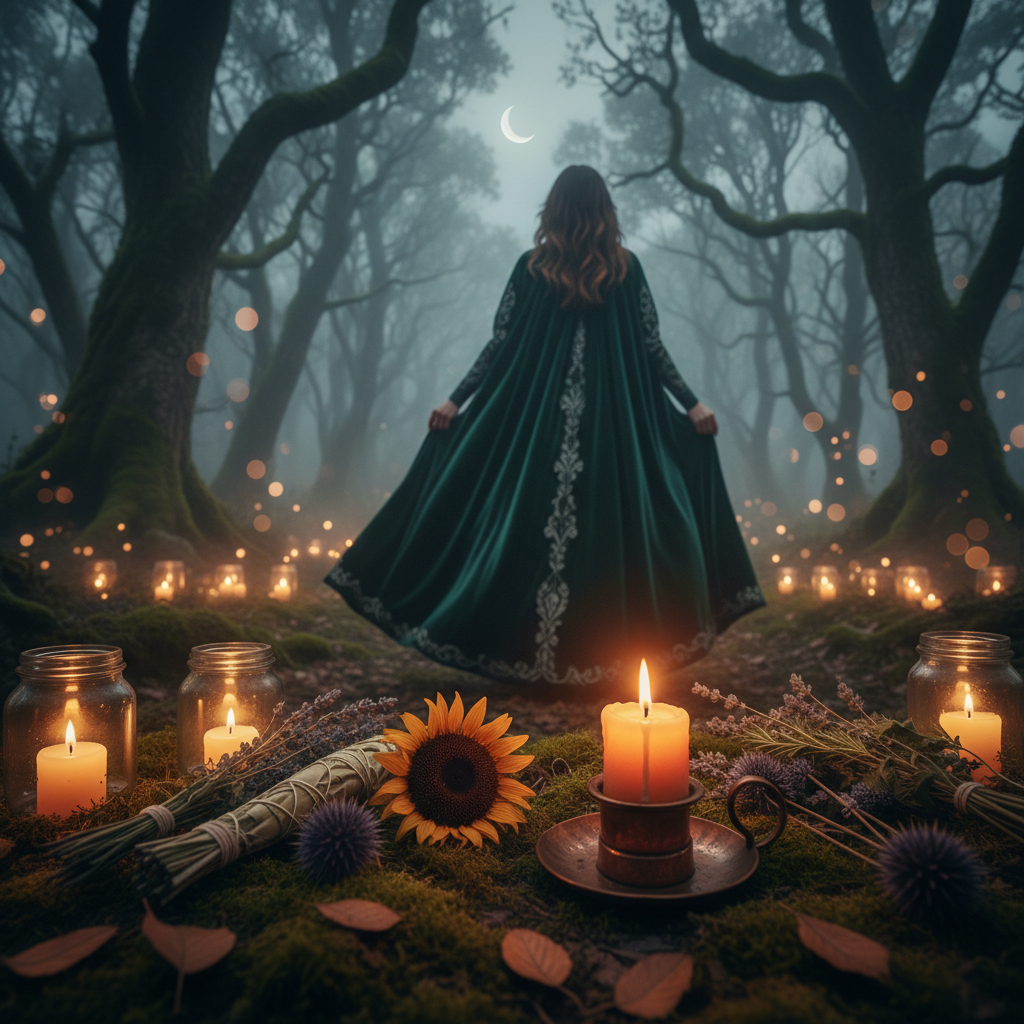
Sometimes I light a candle.
Sometimes I create a spell jar.
Sometimes I work with herbs.
Sometimes I stand outside beneath the moon.
Sometimes I write something down and burn it.
Sometimes I speak aloud exactly what I am calling into—or releasing from—my life.
Could I simply sit on my couch and think about those things?
Sure.
But human beings have always used ritual.
We light candles when someone has a birthday.
We exchange rings when we marry.
We bring flowers to graves.
We cut ribbons when something begins.
We raise glasses when we celebrate.
We throw dirt onto a coffin when we say goodbye.
We understand instinctively that physical actions can carry meaning.
Witchcraft takes that understanding seriously.
Spellwork Is Prayer
This is probably the simplest way I can explain my own relationship with spellwork:
Spellwork is prayer.
It is prayer with herbs.
Prayer with fire.
Prayer with Earth.
Prayer with symbols.
Prayer with intention.
Prayer that sometimes asks me to participate physically in what I am asking spiritually.
If I create a spell for abundance and then refuse every opportunity that appears in my life, the candle isn't going to come knocking on my door with a bag of money.
If I perform a ritual for self-love and continue treating myself terribly, I have work to do.
Magic doesn't absolve me of participation.
If anything, it asks more of me.
The Witch and the Earth
For many witches, nature isn't merely scenery.
It is teacher.
The moon changes.
The seasons turn.
Plants grow, flower, die, and return.
Animals move according to rhythms most humans have learned to ignore.
The Earth continually demonstrates cycles of creation, destruction, rest, and renewal.
Witchcraft brought me into greater awareness of those rhythms.
I notice the moon.
I notice the seasons.
I notice what is growing around me.
I work with herbs, plants, stones, water, fire, and other natural elements.
Not because I believe owning a crystal makes someone spiritual.
But because physical things can become anchors for intention, relationship, memory, and meaning.
The natural world reminds me that I am not separate from it.
I am part of it.
What About the Dark Stuff?
This is usually where somebody eventually wants to go.
Curses.
Hexes.
Baneful magic.
Dark magic.
Do witches believe in it?
Some do.
Some don't.
Some practice it.
Some absolutely refuse to.
And witches have been arguing about the ethics of magic for a very long time.
There isn't a Witch Supreme Court handing down universal rulings.
For me, the more important question is the same question I would ask about any form of power:
What is my intention, and am I willing to take responsibility for what I do with it?
I believe strongly in protection.
I believe in boundaries.
I believe in removing what does not belong in my space.
I believe in returning my own energy to myself.
And I believe that spiritual practice does not require me to become passive in the face of harm.
But power without reflection can become reckless—whether we're talking about magic, religion, leadership, money, relationships, or anything else.
My practice asks me to be responsible for myself.
Witchcraft Is Not About Giving Away Your Power
This may be the part that matters most to me.
I don't believe a witch, psychic, healer, spiritual teacher, tarot reader, minister, or anyone else should become the authority over your life.
I can pull cards with you.
I can perform ritual with you.
I can teach you something I have learned.
I can share what my intuition is telling me.
But I don't get to own your intuition.
And I don't get to make your choices.
A spiritual practice that makes you increasingly afraid to trust yourself is not the kind of spirituality I want to build.
My practice has done the opposite.
It has taught me to listen more closely.
To question.
To pay attention.
To recognize patterns.
To become more comfortable with mystery.
And to take responsibility for my own choices.
Do You Have to Call Yourself a Witch?
Absolutely not.
You can grow herbs.
Talk to the moon.
Read tarot.
Make altars.
Practice folk magic.
Honor your ancestors.
Work with energy.
Perform rituals.
Celebrate the seasons.
Burn what you're ready to release.
Stand barefoot beneath a full moon and howl if that's what makes your soul happy.
And never use the word witch once.
Labels are supposed to help us describe ourselves.
They aren't supposed to become cages.
For me, witch is a word I have chosen.
I like it.
I claim it.
I don't need to make it smaller or more comfortable so that someone else isn't frightened by it.
Maybe the Witch Was Never What You Were Told
For centuries, the word witch has carried fear, fascination, accusation, rebellion, mystery, folklore, religion, persecution, fantasy, and power.
That's a lot for one little word to carry.
Today, when I call myself a witch, I'm not claiming to speak for every person who uses that word.
I'm speaking for myself.
For me, being a witch means living intentionally.
It means remembering my relationship with the Earth.
It means listening to my intuition while keeping my discernment.
It means honoring mystery without needing to explain everything.
It means creating ritual around the moments that matter.
It means understanding that my words, choices, attention, and intentions have power.
It means knowing when to release.
Knowing when to protect.
Knowing when to sit quietly.
Knowing when to light the fucking candle.
And perhaps most importantly, it means remembering that the power I spent so much of my life looking for outside of myself was never really out there.
It was here.
So, what is a witch?
Ask ten witches and you'll probably get eleven answers.
This one is mine.
— Angela Love The Ascension Journal
Explore Topics
Written by
Angela Love
Content creator and writer sharing insights and stories.